lunedì 22 aprile 2019
mercoledì 14 agosto 2013
Business trips in 2012
- India (5 times), with trips to forts and hills around Pune
- China (5 times), including a trip to Beijing (Forbidden City, the Great Wall, Tian An Men, temples)
- Brasil (1 time), including a trip to Iguaçu Falls (a real wonder)
- Northern Ireland (3 times), with trips to Slieve League Cliffs (Donegal) and Dunluce Castle (Antrim)
- China (5 times), including a trip to Beijing (Forbidden City, the Great Wall, Tian An Men, temples)
- Brasil (1 time), including a trip to Iguaçu Falls (a real wonder)
- Northern Ireland (3 times), with trips to Slieve League Cliffs (Donegal) and Dunluce Castle (Antrim)
Leisure trips in 2012
Here are the places I have been for leisure (vacation or week-end trips) in 2012 (with my wife) :
- Gdansk (Poland), including Frombork (March)
- Rome (June)
- Otranto (July)
- Krakow and Gdansk, including the eastern Baltic coast (August)
- Gargano peninsula (September)
- Gdansk, including Torun, and then Nurnberg and Regensburg in Germany (November)
- Gdansk (Poland), including Frombork (March)
- Rome (June)
- Otranto (July)
- Krakow and Gdansk, including the eastern Baltic coast (August)
- Gargano peninsula (September)
- Gdansk, including Torun, and then Nurnberg and Regensburg in Germany (November)
domenica 3 luglio 2011
GDANSK, JUNE 2011
During the first week-end of June, with my wife we went again to Gdansk, to visit our son living there.
It takes 1650 km, 15 hours, to go there by car, but it's not difficult.
There were two nice days, sunny and hot.
Saturday we toured a hilly region west of Gdansk, "Kashubska", with lakes and forests; at evening, we went to Gdansk historical center, and we had dinner in a typical restaurant with a microbrewery.
On sunday, we went to the Baltic Sea coast, at Leba, a crowded sea resort. I didn't think that early June there could be so many people at the sea such north!
When returning home on monday, we made a short detour after Nurnberg, stopping at Rothenburg ob der Tauber, a very nice medioeval village in the Svevian hills.
It takes 1650 km, 15 hours, to go there by car, but it's not difficult.
There were two nice days, sunny and hot.
Saturday we toured a hilly region west of Gdansk, "Kashubska", with lakes and forests; at evening, we went to Gdansk historical center, and we had dinner in a typical restaurant with a microbrewery.
On sunday, we went to the Baltic Sea coast, at Leba, a crowded sea resort. I didn't think that early June there could be so many people at the sea such north!
When returning home on monday, we made a short detour after Nurnberg, stopping at Rothenburg ob der Tauber, a very nice medioeval village in the Svevian hills.
BACK TO DUBLIN
At the beginning of June, I returned in Ireland, and I had the chance to stop again in Dublin.
I walked through the town center, saw some monuments, crowded streets with the ubiquitous irish pubs. I stopped (and had a beer ..) in John Mulligan's, The Porterhouse, and The Temple Bar.
Then I had dinner at an irish restaurant (Quays on Temple Bar street).
Again, worth a visit.
I walked through the town center, saw some monuments, crowded streets with the ubiquitous irish pubs. I stopped (and had a beer ..) in John Mulligan's, The Porterhouse, and The Temple Bar.
Then I had dinner at an irish restaurant (Quays on Temple Bar street).
Again, worth a visit.
sabato 2 luglio 2011
A GLIMPSE OF IRELAND
At the end of May, I have been again in Ireland. This time, when traveling from and to the Dublin Airport, I stopped in small places:
- Monasterboice, where there are impressive "celtic crosses"
- Mellifont Abbey, with the ruines of a cistercian abbey
- Drogheda
- and Carlingford, on the Cooley Peninsula.
- Monasterboice, where there are impressive "celtic crosses"
- Mellifont Abbey, with the ruines of a cistercian abbey
- Drogheda
- and Carlingford, on the Cooley Peninsula.
mercoledì 25 maggio 2011
MORE ABOUT IRISH BEERS
Beer Styles
There are basically two types of beer: ales and lagers.
Ales are top-fermented beers. Top-fermenting yeast thrives in warmer temperatures and withstands higher alcohol concentrations. The resulting beers are generally crisp, sweet, flavorsome, somewhat fruity and lack carbonation. Stout beers are part of the ale family. They are dense and dark, and you might notice a hint of chocolate on your palate. Stouts are brewed from a base of roasted malt.
Lagers are bottom-fermented beers. They are stored at low temperatures for longer periods of time (weeks to months — the word lager comes from the German word lagern, "to store") and become mellow, clear and carbonated. Lagers are typically light-colored with a mild hop flavor and strong carbonation.
Cream Ale is a hybrid of ale and lager. Basically it's ale-fermented at a lower temperature and then conditioned like a lager (low temperature). Cream ale colors range from amber to red. They are smooth and well-rounded with a hint of hops.
STOUTS
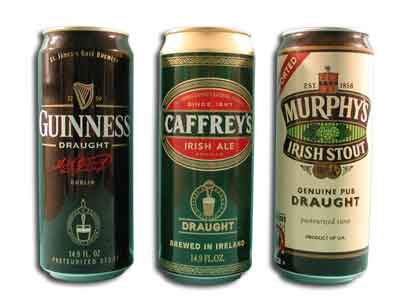
Guinness Draught
The milkshake of beers, this "meal in a bottle" has that roasted malt flavor and hint of chocolate we've come to expect from most full-bodied beers. A rich and creamy Irish favorite for centuries, this hearty brew is best straight out of the bottle or, if it's canned, from a tulip-shaped pint glass. Ask your bartender for a "perfect pint," an optimal pouring method which, according to the company, should take 119.53 seconds. Can't wait that long? Just think of how happy you'll be when that fluffy white cloud forms at the top of your glass, distinctive of "draught" or nitrogen-infused brews. Warning: May put hair on your chest.
Guinness Foreign Extra Stout
Brewed with more hops than domestic Guinness, this version was intended to last longer in warm climates and so survive the lengthy sea journey abroad, since hops act as a vital preservative. Moreover, it has the happy effect of enhancing the beer's flavor and strength. The Foreign Extra Stout is Guinness' strongest beer at 7.5 per cent alcohol by volume. With a dark color that belies its rich, chocolaty taste, this stout goes down smoother than Guinness Draught, and with less bitterness.
Beamish Stout
Often compared to Guinness, Beamish is dark and chocolaty like its more famous cousin, but features a slightly lighter body and spicier bite. Before it hits your lips, this stout goes through a two-week brewing process using the original Beamish yeast, dating back to 1792. It is well worth the wait — sweet flavors of caramel and hints of coffee balance out the bitter, hoppy finish. Like Guinness, Beamish comes in a nitro-can to simulate the taste and texture of a freshly-poured pint for a result that is truly bittersweet.
Murphy's Irish Stout
The lightest and sweetest of Ireland's Big Three (Guinness, Beamish and Murphy's), Murphy's Irish Stout is the "nice guy" of the group. But don't be deceived — that just means you can drink more of ‘em. Think chocolate milk topped with a double shot of espresso and finished with a one-inch thick head of caramel-infused creamy goodness. Since the company's acquisition by Heineken in 1983, Murphy's has been enjoying a reputation as one of the fastest growing stout brands in the world. Have a Guinness for dinner, but save this one for dessert.
Ohara's Celtic Stout (Carlow Brewery)
Carlow Brewery is what you would call old school. Its name comes from Carlow, a small town located in Ireland's historic Barrow Valley region and home to a once-thriving craft beer scene. In the 1800s, crafting your own beer was a popular practice among the inhabitants of Carlow, but this ended with the takeover of small breweries by big business. Carlow Brewing Company, founded in 1996, is reviving this olde tyme way of producing beers long lost, motivated by the belief that their way of manufacturing beers is superior to modern methods.
O'Hara's Celtic Stout is true to the original Irish stout. It's a robust, full-bodied combination of hops and roasted barley, providing both sweetness and a roasty bite with no artificial additives. Just hops, barley, yeast and water — that's it. (Really makes you wonder what you're drinking in all those other beers.) If you're looking for the real deal, this is it.
CREAM ALES
Kilkenny Irish Cream Ale
Kilkenny has friends in high places. Guinness brews it; Diageo, the world's largest producer of spirits (Smirnoff, Johnnie Walker, Jose Cuervo, Bailey's and Guinness) carries it; and Smithwick's, Ireland's oldest brewery, is where it originated. The beer is older than some countries, with a heritage dating back to the fourteenth century.

The taste can be described as Smithwick's with less hops and a creamy head like Guinness. The amber brew has the rich aroma and flavor of toasted malt. It's all at once sweet and creamy, offset by some bitterness and is available in both draught (nitrogen-infused) and canned forms.
ALES
Murphy's Irish Red
Irish red ales get their reddish hue from the small amounts of roasted barley they contain. Some manufacturers artificially color their beers red, and as a result some beers labeled "red ales" are not truly so. In America, darker amber ales are also sometimes labeled as "red ales."
Murphy's Irish Red was originally brewed as Lady's Well Ale in 1856. Lady's Well, located across from the company's brewery in Cork, has been a religious site for Catholics since the eighteenth century. Dutch beer juggernauts Heineken International purchased the brewery in 1983.
This true Irish red is dry, crisp, hoppy and very carbonated with some signs of fruit and caramel.
Smithwick's Irish Ale
This beer is so old, it dates back to the fourteenth century when monks would brew their own next door to the Smithwick's brewery. The ruins of the original Franciscan abbey that once stood there can still be seen. Smithwick's is Ireland's oldest operating brewery, the major ale producer in Ireland and, along with Guinness, part of Diageo.
Like Murphy's Irish Red, this is a red ale characterized by caramel maltiness and a hint of hops.
There are basically two types of beer: ales and lagers.
Ales are top-fermented beers. Top-fermenting yeast thrives in warmer temperatures and withstands higher alcohol concentrations. The resulting beers are generally crisp, sweet, flavorsome, somewhat fruity and lack carbonation. Stout beers are part of the ale family. They are dense and dark, and you might notice a hint of chocolate on your palate. Stouts are brewed from a base of roasted malt.
Lagers are bottom-fermented beers. They are stored at low temperatures for longer periods of time (weeks to months — the word lager comes from the German word lagern, "to store") and become mellow, clear and carbonated. Lagers are typically light-colored with a mild hop flavor and strong carbonation.
Cream Ale is a hybrid of ale and lager. Basically it's ale-fermented at a lower temperature and then conditioned like a lager (low temperature). Cream ale colors range from amber to red. They are smooth and well-rounded with a hint of hops.
STOUTS
Guinness Draught
The milkshake of beers, this "meal in a bottle" has that roasted malt flavor and hint of chocolate we've come to expect from most full-bodied beers. A rich and creamy Irish favorite for centuries, this hearty brew is best straight out of the bottle or, if it's canned, from a tulip-shaped pint glass. Ask your bartender for a "perfect pint," an optimal pouring method which, according to the company, should take 119.53 seconds. Can't wait that long? Just think of how happy you'll be when that fluffy white cloud forms at the top of your glass, distinctive of "draught" or nitrogen-infused brews. Warning: May put hair on your chest.
Guinness Foreign Extra Stout
Brewed with more hops than domestic Guinness, this version was intended to last longer in warm climates and so survive the lengthy sea journey abroad, since hops act as a vital preservative. Moreover, it has the happy effect of enhancing the beer's flavor and strength. The Foreign Extra Stout is Guinness' strongest beer at 7.5 per cent alcohol by volume. With a dark color that belies its rich, chocolaty taste, this stout goes down smoother than Guinness Draught, and with less bitterness.
Beamish Stout
Often compared to Guinness, Beamish is dark and chocolaty like its more famous cousin, but features a slightly lighter body and spicier bite. Before it hits your lips, this stout goes through a two-week brewing process using the original Beamish yeast, dating back to 1792. It is well worth the wait — sweet flavors of caramel and hints of coffee balance out the bitter, hoppy finish. Like Guinness, Beamish comes in a nitro-can to simulate the taste and texture of a freshly-poured pint for a result that is truly bittersweet.
Murphy's Irish Stout
The lightest and sweetest of Ireland's Big Three (Guinness, Beamish and Murphy's), Murphy's Irish Stout is the "nice guy" of the group. But don't be deceived — that just means you can drink more of ‘em. Think chocolate milk topped with a double shot of espresso and finished with a one-inch thick head of caramel-infused creamy goodness. Since the company's acquisition by Heineken in 1983, Murphy's has been enjoying a reputation as one of the fastest growing stout brands in the world. Have a Guinness for dinner, but save this one for dessert.
Ohara's Celtic Stout (Carlow Brewery)
Carlow Brewery is what you would call old school. Its name comes from Carlow, a small town located in Ireland's historic Barrow Valley region and home to a once-thriving craft beer scene. In the 1800s, crafting your own beer was a popular practice among the inhabitants of Carlow, but this ended with the takeover of small breweries by big business. Carlow Brewing Company, founded in 1996, is reviving this olde tyme way of producing beers long lost, motivated by the belief that their way of manufacturing beers is superior to modern methods.
O'Hara's Celtic Stout is true to the original Irish stout. It's a robust, full-bodied combination of hops and roasted barley, providing both sweetness and a roasty bite with no artificial additives. Just hops, barley, yeast and water — that's it. (Really makes you wonder what you're drinking in all those other beers.) If you're looking for the real deal, this is it.
CREAM ALES
Kilkenny Irish Cream Ale
Kilkenny has friends in high places. Guinness brews it; Diageo, the world's largest producer of spirits (Smirnoff, Johnnie Walker, Jose Cuervo, Bailey's and Guinness) carries it; and Smithwick's, Ireland's oldest brewery, is where it originated. The beer is older than some countries, with a heritage dating back to the fourteenth century.
The taste can be described as Smithwick's with less hops and a creamy head like Guinness. The amber brew has the rich aroma and flavor of toasted malt. It's all at once sweet and creamy, offset by some bitterness and is available in both draught (nitrogen-infused) and canned forms.
ALES
Murphy's Irish Red
Irish red ales get their reddish hue from the small amounts of roasted barley they contain. Some manufacturers artificially color their beers red, and as a result some beers labeled "red ales" are not truly so. In America, darker amber ales are also sometimes labeled as "red ales."
Murphy's Irish Red was originally brewed as Lady's Well Ale in 1856. Lady's Well, located across from the company's brewery in Cork, has been a religious site for Catholics since the eighteenth century. Dutch beer juggernauts Heineken International purchased the brewery in 1983.
This true Irish red is dry, crisp, hoppy and very carbonated with some signs of fruit and caramel.
Smithwick's Irish Ale
This beer is so old, it dates back to the fourteenth century when monks would brew their own next door to the Smithwick's brewery. The ruins of the original Franciscan abbey that once stood there can still be seen. Smithwick's is Ireland's oldest operating brewery, the major ale producer in Ireland and, along with Guinness, part of Diageo.
Like Murphy's Irish Red, this is a red ale characterized by caramel maltiness and a hint of hops.
martedì 24 maggio 2011
IRISH BEERS
In my own home country, I like and drink wine. I have never drunk beers. Actually, I don't like "yellow" beers (lagers or whatever they are called).
But abroad, I discovered (an easy discovery, surely) that there are different different types of beers, and I started appreciating dark beers, brown (stouts) or red (ales). "Weizen" beers still I don't like a lot, but when there are no darker beers ...
Irish beers are particularly tasteful for me. Here is an excerpt from another site I found listing Irish beers.
Ireland is particularly known for two beer styles - The Irish Red (which is an Amber-colored Pale Ale, usually featuring a caramel malt backbone with a bready/yeasty undertone and a light, earthy bitterness), and the Dry Stout (which has a very coffee-like, dry taste to it, hence the name).
If you want to get your inner Irishman (or Irishwoman) on, here's a list of beers that should do it for you with good style, flavor, and class:
1. Guinness: The most well-known Irish beer. Takes on many forms, Irish Guinness (such as Foreign Extra Stout or Special Export Stout) gets top marks with an "A-" or an "A" rating depending on which one.
2. Smithwick's: (Pronounced "Smid-icks"), a very good Irish Red Ale brewed by Guinness. A nice caramel malty backbone with some yeasty/bready undertones and a mild tea-like bitterness. A "B" on my rating scale, and one of my favorite all-time session beers.
3. O'Hara's Irish Red Ale: From the Carlow Brewing Company. A very low alcohol content beer (4.3%). A bit more intense hop bite than Smithwick's, with the same amount of sweet caramel goodness, and some fruity and floral undertones as well. A great all-around beer, a "B+" on my scale.
4. Caffrey's Irish Ale: Similar to Smithwicks, though usually served out of a Nitro can. Heads up much like fresh-from-the-tap Guinness, though not too big on flavor. Would be a good option for those of you that like lighter beers, if you can find it (it can be difficult). A "B-" rating.
5. Beamish Irish Stout: Served usually in a Nitro Can like canned Guinness Draught. Has that classic Irish Dry Stout taste - coffee, chocolate malt, and a fair amount of bitterness. It's rather creamy and smooth though. It's really good. A "B+" from me.
6. Murphy's Stout: Much like Guinness Draught or Beamish, served in Nitro cans. A fair bit sweeter than either Beamish or Guinness, but a very good, drinkable stout nonetheless. A "B+" Beer and winner for sure.
But abroad, I discovered (an easy discovery, surely) that there are different different types of beers, and I started appreciating dark beers, brown (stouts) or red (ales). "Weizen" beers still I don't like a lot, but when there are no darker beers ...
Irish beers are particularly tasteful for me. Here is an excerpt from another site I found listing Irish beers.
Ireland is particularly known for two beer styles - The Irish Red (which is an Amber-colored Pale Ale, usually featuring a caramel malt backbone with a bready/yeasty undertone and a light, earthy bitterness), and the Dry Stout (which has a very coffee-like, dry taste to it, hence the name).
If you want to get your inner Irishman (or Irishwoman) on, here's a list of beers that should do it for you with good style, flavor, and class:
1. Guinness: The most well-known Irish beer. Takes on many forms, Irish Guinness (such as Foreign Extra Stout or Special Export Stout) gets top marks with an "A-" or an "A" rating depending on which one.
2. Smithwick's: (Pronounced "Smid-icks"), a very good Irish Red Ale brewed by Guinness. A nice caramel malty backbone with some yeasty/bready undertones and a mild tea-like bitterness. A "B" on my rating scale, and one of my favorite all-time session beers.
3. O'Hara's Irish Red Ale: From the Carlow Brewing Company. A very low alcohol content beer (4.3%). A bit more intense hop bite than Smithwick's, with the same amount of sweet caramel goodness, and some fruity and floral undertones as well. A great all-around beer, a "B+" on my scale.
4. Caffrey's Irish Ale: Similar to Smithwicks, though usually served out of a Nitro can. Heads up much like fresh-from-the-tap Guinness, though not too big on flavor. Would be a good option for those of you that like lighter beers, if you can find it (it can be difficult). A "B-" rating.
5. Beamish Irish Stout: Served usually in a Nitro Can like canned Guinness Draught. Has that classic Irish Dry Stout taste - coffee, chocolate malt, and a fair amount of bitterness. It's rather creamy and smooth though. It's really good. A "B+" from me.
6. Murphy's Stout: Much like Guinness Draught or Beamish, served in Nitro cans. A fair bit sweeter than either Beamish or Guinness, but a very good, drinkable stout nonetheless. A "B+" Beer and winner for sure.
giovedì 19 maggio 2011
TWO DAYS IN ROME
At mid-May with my wife (and grandparents) we spent two days in Rome.
It is surely the city with the largest number of monuments in the world.
This time we visited San Paolo fuori le Mura, Colosseum, St. Peter, Fountain of Trevi (at night and in the morning), S. Trinità dei Monti, Piazza di Spagna, Palazzo del Quirinale, Piazza Farnese with S. Brigida.
I am always impressed by Rome, by its "monumentality" and by its hidden gems; it would take months to thoroughly visit it.
It is surely the city with the largest number of monuments in the world.
This time we visited San Paolo fuori le Mura, Colosseum, St. Peter, Fountain of Trevi (at night and in the morning), S. Trinità dei Monti, Piazza di Spagna, Palazzo del Quirinale, Piazza Farnese with S. Brigida.
I am always impressed by Rome, by its "monumentality" and by its hidden gems; it would take months to thoroughly visit it.
giovedì 28 aprile 2011
Dublin 2011 april
Just before Easter, I had a business trip to Northern Ireland. Landing in and leaving from Dublin, I had the chance to spend some hours in Dublin in the late afternoon and evening.
So I visited the center of the city, walking from the Guinness Factory to St. Patrick Cathedral, then Great Georges Road, then Dublin Castle (it was closed) then the Temple Bar area, finishing the day at the Long Hall pub (to have an irish beer, a Smithwicks).
A nice city, to be visited again.
sabato 16 aprile 2011
I BOUGHT IT: THE CANON EOS-550D!
In a previous post, talking about cameras, I mentioned I was having a "dream" (I agree there are better dreams ...), the Canon EOS-550D.
And yes, during my business trip in Japan early April, I bought it, at a BIC Camera shop in Kyoto.
I bought the camera with the standard 18-55 EF-S IS lens, plus a 55-250 EF-S IS additional lens; totally for just above 600 €, a bargain.
After having used it for some time, the real difference is in the low-light performances: even at high ISO levels, pictures are sharp and clear.
And yes, during my business trip in Japan early April, I bought it, at a BIC Camera shop in Kyoto.
I bought the camera with the standard 18-55 EF-S IS lens, plus a 55-250 EF-S IS additional lens; totally for just above 600 €, a bargain.
After having used it for some time, the real difference is in the low-light performances: even at high ISO levels, pictures are sharp and clear.
JAPAN: KYOTO
From March, 27th to April, 10th I have done a business trip to China (Suzhou, where my company has a plant) and Japan, to visit a customer, located in Shiga prefecture.
While in Japan, I had the chance to make a trip to Kyoto, on april 4th, to visit some temples.
It was a nice spring day, but cherry trees blossoming was just starting, so it was marginal. Nevertheless, the sites I visited were very nice: the three temples Kinkaku-ji, Ryoan-ji, and Ninna-ji.
I like Japan a lot, and leaving it is always a pain for me!
Actually, this was my tenth time in Japan!
Some pictures here below.
While in Japan, I had the chance to make a trip to Kyoto, on april 4th, to visit some temples.
It was a nice spring day, but cherry trees blossoming was just starting, so it was marginal. Nevertheless, the sites I visited were very nice: the three temples Kinkaku-ji, Ryoan-ji, and Ninna-ji.
I like Japan a lot, and leaving it is always a pain for me!
Actually, this was my tenth time in Japan!
Some pictures here below.
sabato 19 marzo 2011
BUSINESS TRIP TO DENMARK
In the week from 14th to 18th March, I visited two suppliers in Denmark, one in Nordborg (south Jilland) and one in Aars (close to Aalborg).
TRIP TO GDANSK, POLAND
During the week-end of 4th to 7th March, with my wife we traveled to Gdansk, Poland, to visit our son, that's living and working there since January.
We went there by car, it was a 1650 km trip! But in 16 hours we were there, without any problems along the road.
Gdansk is a very beautiful city, with an impressive historical center. Weather was cold but sunny.
We will return!
We went there by car, it was a 1650 km trip! But in 16 hours we were there, without any problems along the road.
Gdansk is a very beautiful city, with an impressive historical center. Weather was cold but sunny.
We will return!
domenica 27 febbraio 2011
BUSINESS TRIP TO IRELAND
Last week I had to visit a customer in Northern Ireland. I like Ireland, for its landscapes, gentle and dramatic, for the buildings, the people, and the pubs with their atmosphere and beer.
But this time I had no spare time to enjoy the country.
KONKAN COAST
The coast of the Maharashtra state, facing the Arabian Sea, is known as "Konkan". It extends south of Mumbai, for some hundreds kilometers.
It's not the favourite sea destination in India (Goa and the Kerala coast are much more popular), but it has some interesting spots.
I have been in some of them, in its northern stretch. I left from Pune early in the morning, taking a less trafficked road that crosses the Ghats right west of Pune, along the Mulshi lake, with some interesting views.
I reached the coast initially at Janjira (about 170 km from Pune), where there is an imposing fort built on an island few hundreds of meters off the beach. I watched the fort from the village only, since the waiting time for the boats was too much.
Then I moved north to Murud, a nearby small fishing town with a long beach.
The best and most known beach in the area is Kashid, with white sand, palms in the back, and quite clear waters; the beach was crowded by families and groups of friends. Many were having fun with some water sports, like riding water-bikes. I saw only one family of non-Indians.
Further north there is the beach of Nagaon, whose the sand is more gray-ish.
My trip lasted in Alibag, a city that has become a favourite spot for Mumbai's high class as a resort. But the beach right in the center of the town was not inspiring, to my taste.
All in all it was an interesting trip. However, the coast and the sea, despite agreable, were not as beautiful as the coasts in certain parts of Italy, Sardinia, Puglia, Sicily, or Cilento in Campania. But I can be a little partisan for my country ...
View Larger Map
Some photos, from my Picasa album ..
It's not the favourite sea destination in India (Goa and the Kerala coast are much more popular), but it has some interesting spots.
I have been in some of them, in its northern stretch. I left from Pune early in the morning, taking a less trafficked road that crosses the Ghats right west of Pune, along the Mulshi lake, with some interesting views.
I reached the coast initially at Janjira (about 170 km from Pune), where there is an imposing fort built on an island few hundreds of meters off the beach. I watched the fort from the village only, since the waiting time for the boats was too much.
Then I moved north to Murud, a nearby small fishing town with a long beach.
The best and most known beach in the area is Kashid, with white sand, palms in the back, and quite clear waters; the beach was crowded by families and groups of friends. Many were having fun with some water sports, like riding water-bikes. I saw only one family of non-Indians.
Further north there is the beach of Nagaon, whose the sand is more gray-ish.
My trip lasted in Alibag, a city that has become a favourite spot for Mumbai's high class as a resort. But the beach right in the center of the town was not inspiring, to my taste.
All in all it was an interesting trip. However, the coast and the sea, despite agreable, were not as beautiful as the coasts in certain parts of Italy, Sardinia, Puglia, Sicily, or Cilento in Campania. But I can be a little partisan for my country ...
View Larger Map
Some photos, from my Picasa album ..
Iscriviti a:
Post (Atom)